Every home's water meter records exactly how much water passes into the property, which makes it the single best tool for answering "do I have a leak?" You do not need any special skill to use it — just the ability to find the meter box, read numbers off a dial or screen, and wait.
This guide covers all three parts: locating your meter, reading the two common meter types, and running the no-water test that exposes hidden leaks. Once you know how, you can check for a leak any time in about ten minutes. It is also the first skill to reach for when investigating a suddenly high water bill.
In This Article
Finding Your Water Meter
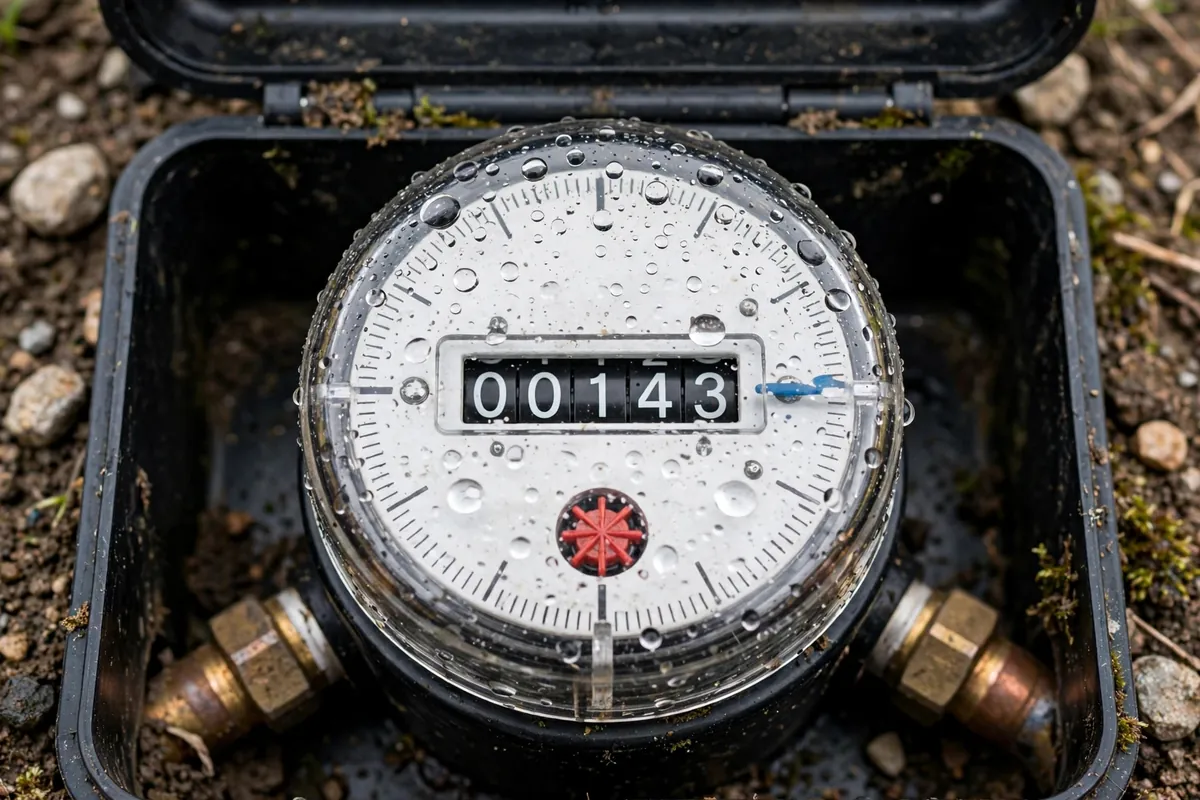
In most Leesburg neighborhoods, the water meter lives in a ground-level box near the street or sidewalk, usually in line with the front of your property. Look for a rectangular concrete or plastic lid, often marked "water" or "meter."
- Lift the lid carefully. Meter boxes collect dirt, insects, and occasionally standing water. Use a screwdriver or a gloved hand, and watch where you put your fingers.
- Clear the view. Brush dirt off the meter face. If the box is full of water, that itself is worth noting — it can indicate a leak at or near the meter — but bail or wait rather than guessing at a submerged dial.
- Note the shutoff valve. While you are there, locate the customer-side shutoff valve in or near the box. Knowing where it is now saves panic later.
- Do not force anything. If the lid is stuck, the box is damaged, or the meter looks tampered with, leave it alone and call the water utility.
If you have never opened the box before, take a photo of the meter face once it is clean. The photo records the exact reading and the meter serial number, which is handy if you ever need to discuss the account with the utility — and it gives you a reference for comparing future readings at a glance.
Reading An Analog Meter
Older and many current meters have a row of number dials under a clear cover, plus one or two special indicators:
- The number dials. Read them left to right, just like an odometer. This is your total usage figure — write it down with the date and time.
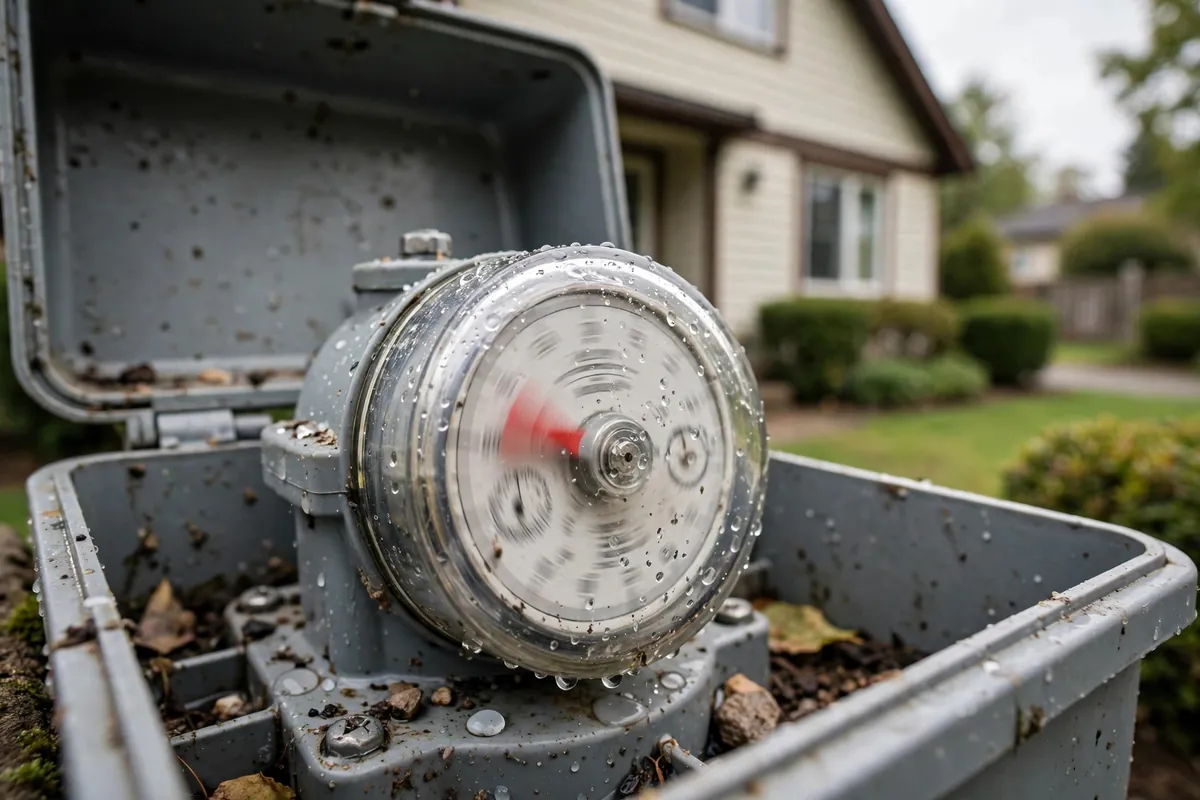
- The sweep hand. A large hand that rotates as water flows. Even a tiny leak keeps this hand creeping, which makes it useful for short observation periods.
- The leak indicator. A small triangle, star, asterisk, or gear-shaped dial that spins with any water movement at all — even a flow too small to move the sweep hand visibly. This little indicator is the fastest leak clue on an analog meter.
If the leak indicator is spinning while everything in the house is off, you have confirmed a leak without reading a single number. Check this first — it takes ten seconds.
Reading A Digital Meter
Newer meters show usage on an electronic display, sometimes with a solar or battery-powered screen that wakes when you shine a light on it or press a button:
- The usage number. The main figure is your total consumption, same as the analog dials. Record it with date and time.
- Flow indicators. Many digital meters show a faucet icon, a flashing triangle, or a "+" / "-" flow symbol when water is currently moving. The exact icon varies by manufacturer — your water utility can tell you what yours means.
- Rate screens. Some displays cycle through screens showing current flow rate. Any nonzero flow with everything off means water is going somewhere.
- Low light. If the display is dark, shade it from direct sun and look closely, or shine a flashlight on the solar cell to wake it.
Digital or analog, the principle is identical: numbers that change while nothing runs mean a leak.
The Two-Hour No-Water Test
This is the definitive homeowner leak test. It takes two readings and a little patience:
- Everyone in the house knows not to use water during the test
- Ice maker, water softener regen, and irrigation all accounted for or off
- Pool autofill switched off
- First meter reading recorded with date and time
- Wait at least two hours with zero water use
- Second reading recorded and compared
Then compare:
- Numbers identical, indicator still: no leak. Your plumbing holds water.
- Numbers moved or indicator spinning: water flowed during the test — you have a leak somewhere on your side of the meter.
For a slower, subtler check, take the readings a full day apart instead of two hours. And if the meter moves fast enough to watch, skip the waiting — see what a spinning meter means and act promptly. A meter moving that fast may warrant our emergency meter leak service rather than a wait-and-see approach.
Keeping A Simple Usage Log
A single meter reading answers "is water flowing right now." A log of readings answers the bigger question: "is my usage drifting upward over time?" Catching a slow drift early is how you find a leak in its first month instead of its fourth.
- Read the meter on the first of each month. Same day, roughly the same time — consistency matters more than precision.
- Write down the number and the date. A notes app, a spreadsheet, or a card taped inside a cabinet all work.
- Compare month to month. Subtract last month’s reading from this month’s to get your actual usage, and compare it to the usage printed on your bill.
- Note anything unusual alongside. Guests, irrigation changes, pool refills — context turns a bare number into an explanation.
After three or four months you will know your home’s normal range, and any future spike will stand out immediately — often before the bill arrives. Pair the log with the monthly leak-indicator glance, and very few leaks will ever surprise you.
What Your Readings Mean
The meter does more than say "leak" or "no leak" — the pattern narrows the search:
| What The Meter Does | What It Likely Means |
|---|---|
| Leak indicator spins steadily with everything off | A continuous leak — toilet, irrigation, service line, or slab |
| Numbers jump only at certain times | An intermittent source — irrigation zone, autofill, or a toilet that runs periodically |
| Meter stops when the house main valve is closed | The leak is inside the house plumbing |
| Meter keeps moving with the house valve closed | The leak is between the meter and the house — service line or yard piping |
| Nothing moves over 24 hours | No current leak — investigate the bill itself or past one-time usage |
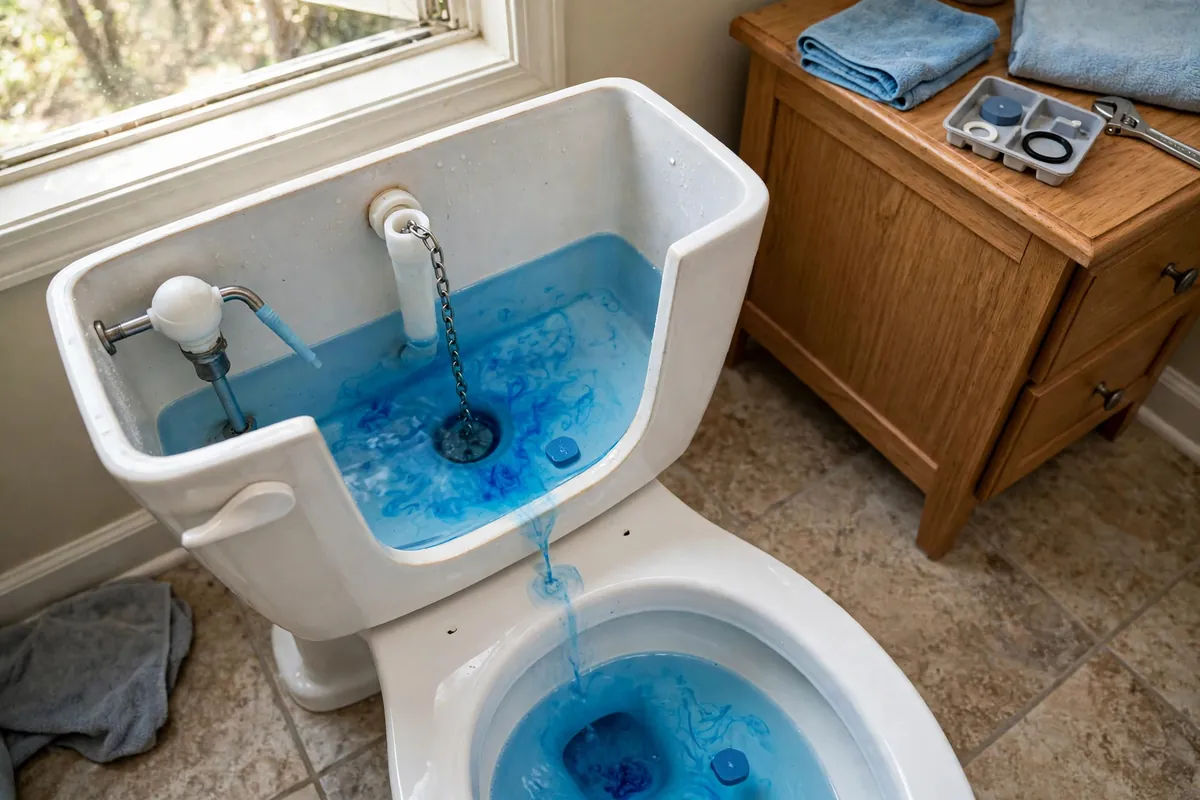
Pair the meter test with the toilet dye test and a walk of the irrigation zones, and most homeowners find their answer without any professional equipment. When the meter says leak but the house and yard show nothing, that is when to call for professional water meter leak investigation or our high-bill leak detection service if the bill is what started your search — hidden leaks in walls, under slabs, and underground are what detection equipment is for.